 Más información


Noticias
Tenga en cuenta que las publicaciones son exactas en el momento de la publicación, pero pueden estar sujetas a cambio sin previo aviso. Esta página muestra solo los elementos más recientes. Para ver el archivo completo de los comunicados de prensa, haga clic en "Buscar por categoría o año".
Mitsubishi Electric Technology Estimates Organic Carbon in Farmland Using Optical Measurements and Soil Organic Carbon Dynamics Models (en inglés)
 PDF Version (PDF:481.2 KB)
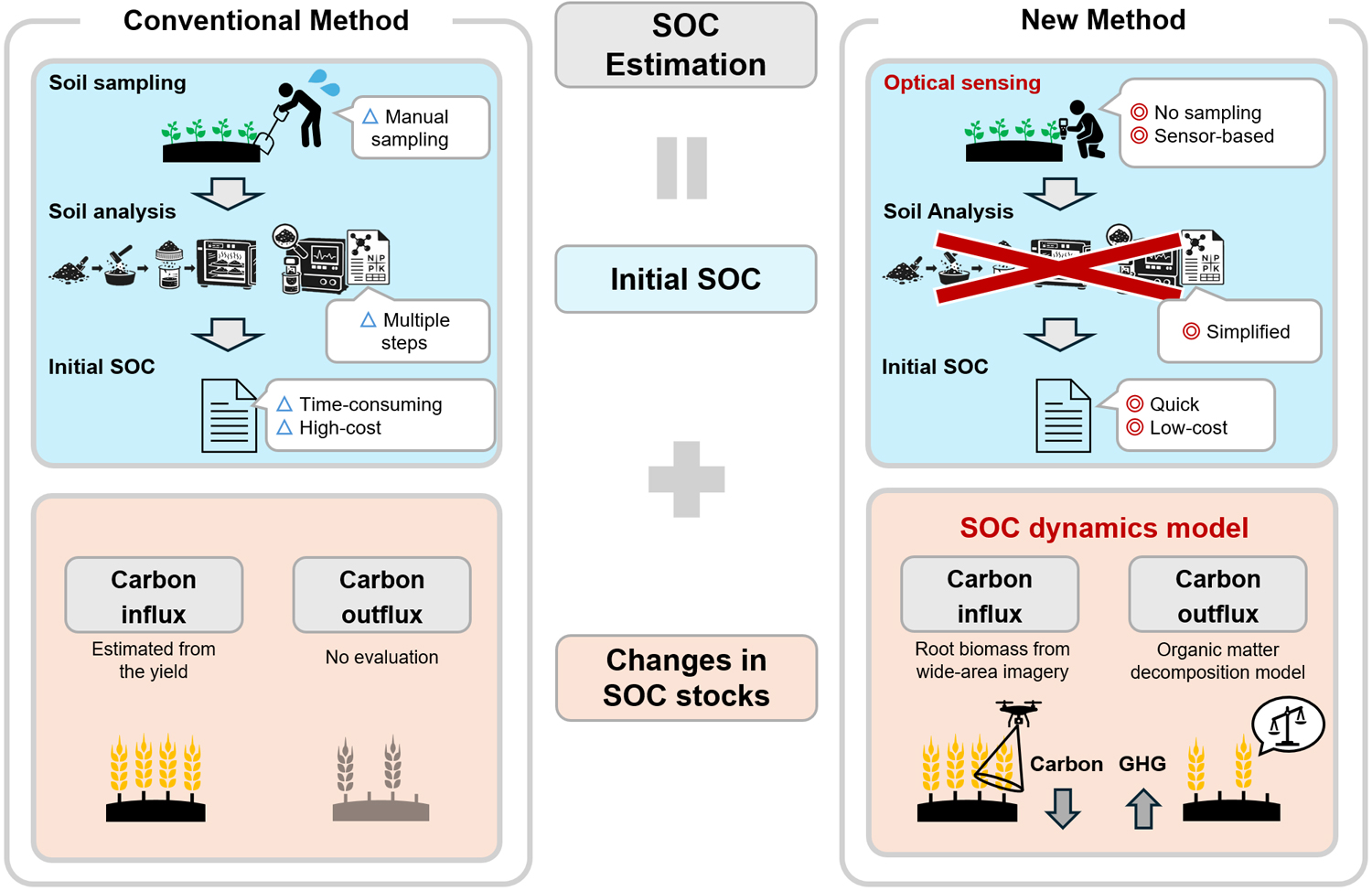
Comparison with conventional technology
TOKYO, May 13, 2026 – Mitsubishi Electric Corporation (TOKYO: 6503) announced today that it has developed a technology to accurately estimate the amount of soil organic carbon (SOC) in agricultural land by combining optical measurements with two SOC dynamic models: a root biomass model1 and a microbially mediated organic matter decomposition model.2 The new technology will enable the efficient, low-cost, large-scale monitoring of SOC by eliminating the need for soil sampling and laboratory chemical analyses. By supporting the evaluation of agriculture‑derived carbon reductions within the GX‑ETS,3 which will be fully operational by the fiscal year ending March 2027, the technology will improve agricultural productivity and reduce greenhouse-gas emissions.
With the acceleration of Green Transformation (GX) policies and corporate and municipal emission‑reduction plans along with the Japanese government’s efforts to achieve its 2050 carbon‑neutral goal, agricultural soil is increasingly recognized as a promising way to store carbon. Benefits include reduced greenhouse gas emissions, improved soil-water retention and increased soil fertility for improved crop production. However, SOC is strongly influenced by biological and chemical processes, specifically microbial decomposition and root growth, and since these processes are difficult to observe directly, extensive soil sampling and laboratory analysis have traditionally been required.
Mitsubishi Electric’s new technology reproduces SOC dynamics by inputting aerial remote-sensing data and ground-based optical measurements into simulation models representing crop root growth and soil metabolic processes. In a demonstration in Toyotomi-cho, Hokkaido, Japan, the company confirmed that the technology can evaluate SOC across wide areas at low cost and substantially improves accuracy compared to conventional methods. The technology supports the preparation of various reports by providing data that can serve as objective evidence for third-party verification in monitoring, reporting and verification (MRV) required under the GX-ETS. Going forward, Mitsubishi Electric will conduct more demonstrations on different types of agricultural land in Japan and abroad, aiming to contribute to increased agricultural productivity, reduced greenhouse‑gas emissions and a more carbon‑neutral world.
- 1
A calculation method that predicts changes in SOC and nutrient levels by quantifying plant root biomass and growth dynamics.
- 2
A model that predicts the rate of organic‑matter decomposition by microbial activity and the associated carbon emissions.
- 3
A greenhouse gas emissions trading scheme in Japan, scheme in which companies set greenhouse gas emissions reduction targets and, through actual emission reductions as well as trading emission allowances and credits, aim to achieve both carbon neutrality and economic growth.
Inquiry
-
Customer Inquiries
Information Technology R&D Center
Mitsubishi Electric Corporation